The purpose of the tithe commutation Acts, passed in the 1820s and 1830s, was to convert the payments of tithes in agricultural produce, into payments in money. In order to do that, detailed surveys were undertaken to record the ownership and value of every plot of land in almost every parish in the country. The survey documents for our study area are available in Lancashire Archives.
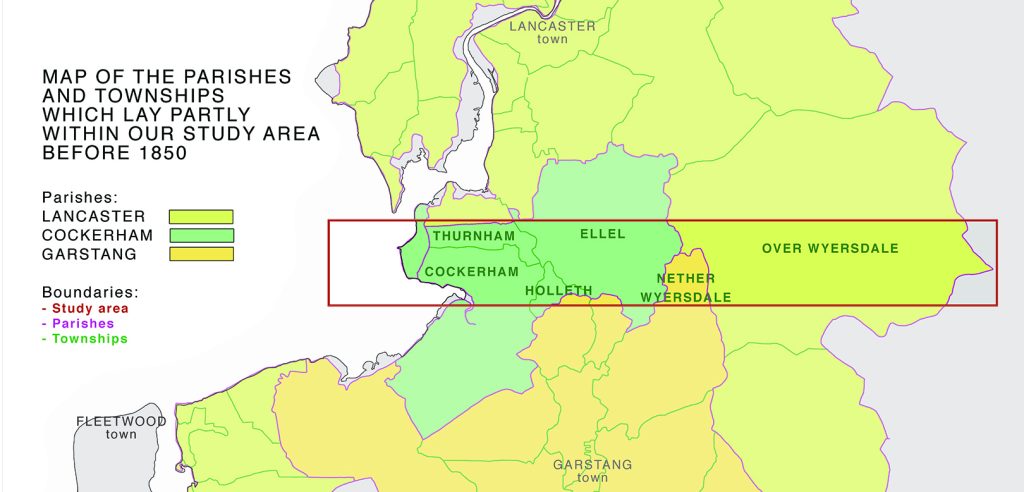
The arrangement of local parishes was different at that time, and they were subdivided into townships. Our study area included parts of Lancaster, Cockerham, and Garstang parishes, and specifically the townships of Over Wyersdale, Cockerham, Ellel, Thurnham, Holleth, and Nether Wyersdale.
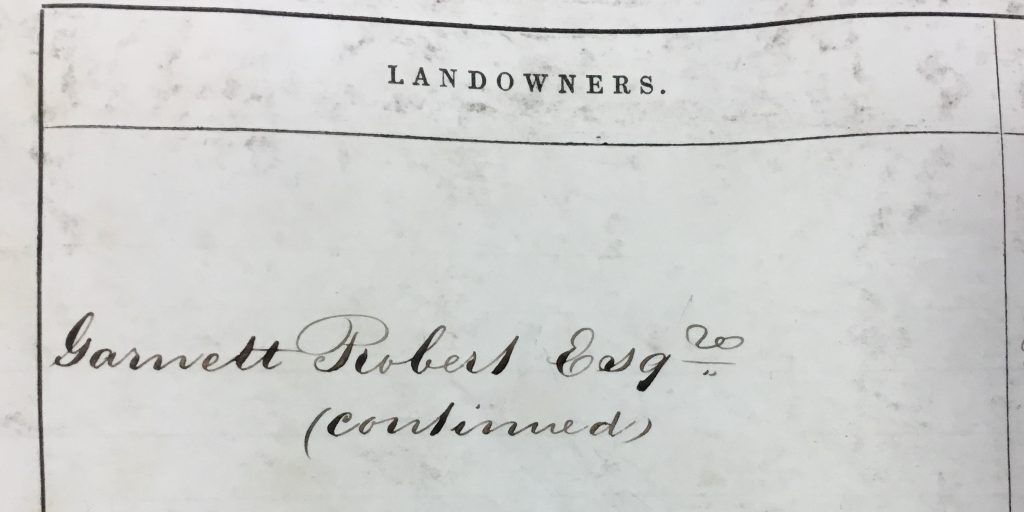
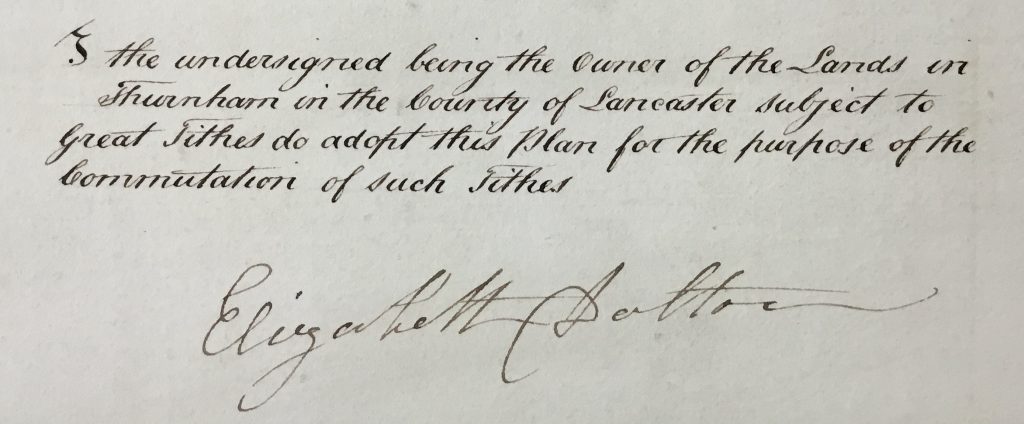
The tithe survey documents for these townships enabled me to obtain the names of the landowners of all plots of land in this area. The land in Ellel township was owned by about 70 individuals, including a few with large areas, but many with fairly small holdings. There were over 40 landowners in Over Wyersdale, the largest being Robert Garnett who acquired the estate of John Fenton Cawthorne after his death, including Wyerside Hall, and had then extended it. Cockerham township was almost entirely owned by only four people, Richard Atkinson, who lived firstly at Cockerham Hall and later at Ellel Grange, Thomas Greene, John Dent, and the ‘Devisees of late Robert Addison’. The Duke of Hamilton and Brandon, who lived at Ashton Hall, owned almost all of both Nether Wyersdale and Holleth. Thurnham township was completely owned by Elizabeth Dalton of Thurnham Hall, who had inherited from her father.
This was the information I had hoped to obtain, and I could have stopped there, but in studying these documents I became intrigued by the complexity of the tithe payments system, and wanted to understand it more clearly.
Through wider reading I learned that tithe payment in kind had been of two main types – great tithes, paid in corn and other grain, and small tithes, paid in all other produce including sheep, pigs, apples, etc. The great tithes were more valuable and went to the rector, who was responsible for the cure of souls in the parish, but he often lived elsewhere and employed a vicar to undertake these duties. The vicar received the small tithes, also known as the vicarial tithes, as his payment.

In many parishes, the role of rector was appropriated by a monastery, which therefore received the great tithes. After the dissolution of the monasteries, the extensive lands which they had owned, covering about a third of England, were first taken by the king, and then sold off to a variety of wealthy men and organisations. Such a transfer of a property from the church to a layman is termed impropriation. These lay purchasers, who then became the recipient of the tithe payments, were known as impropriators, a term which seems to carry a sense of being inappropriate, or even improper. These people did not own the land, but they owned a right which entitled them to receive the tithe payments from the occupiers of that land. These rights were intangible properties which could be legally inherited, sold, leased, or farmed out. After tithes were commuted in the 19th century, the impropriators, like the landowners, now received monetary payments rather than payments in agricultural produce.
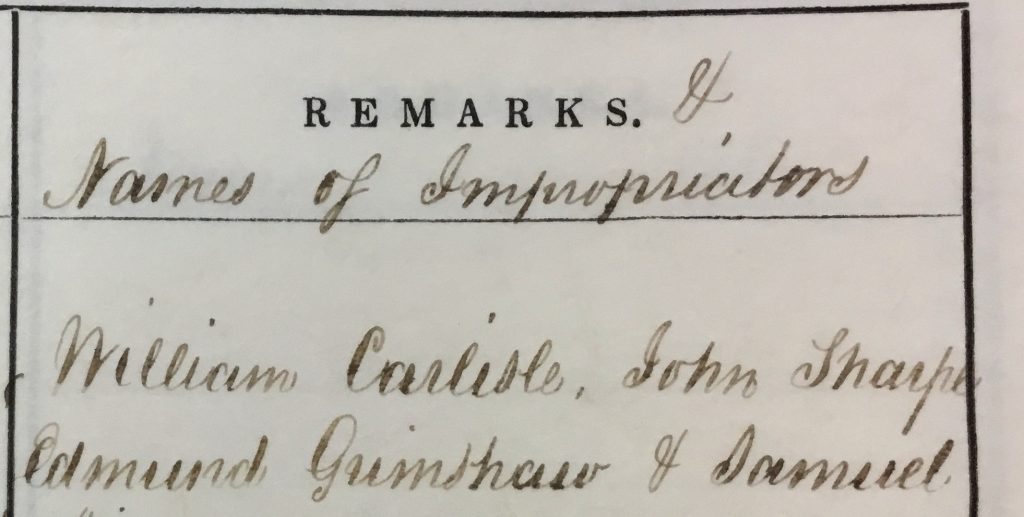
I had not noticed the payments to impropriators in the tithe survey documents at my first reading, because I had been focused simply on landownership, but now when I looked again, I found that the documents also recorded this additional and significant type of income obtained from the land, and specified who owned these rights. Some of these impropriators were local landowners, but many owned no land in the area, and even lived in another part of the country. In Cockerham and Thurnham townships the tithes were largely owned by the landowners, but in over Wyresdale at least some the tithes of corn and hay were owned by a Charles Standish of Standish Hall near Wigan, and in Nether Wyresdale they were paid to John Bourne of Stalmine Hall near Knott End. The situation in Ellel was more complex, with many of the tithes being owned by the landowners, but exceptions included a large area for which the trustees of “Frances Isabella Jackson Spinster of Lancaster” were the impropriators. These tithe rights, also known as corn rents, were a financial investment producing a regular income for their owners.

So, an ancient arrangement which was originally intended to finance the Church, became for many years, for a lot of land, an additional source of income for people who had no role in the church, had no interest in the land itself, and who generally were already wealthy.
After tithe commutation, the conversion to monetary payments made these both more precisely defined and more difficult for the tenants to avoid than payments in agricultural produce, so providing a more reliable income for the owners. This tithe payment system continued into the twentieth century, and although those tenants who could afford it were enabled to make a one-off payment to redeem the tithe charge, most continued to be legally obliged to pay.
In the 1930s there were widespread tithe rebellions, and demonstration marches through London. Thousands of non-payment cases went through the county courts, bailiffs seized possessions, and some farmers went to prison.
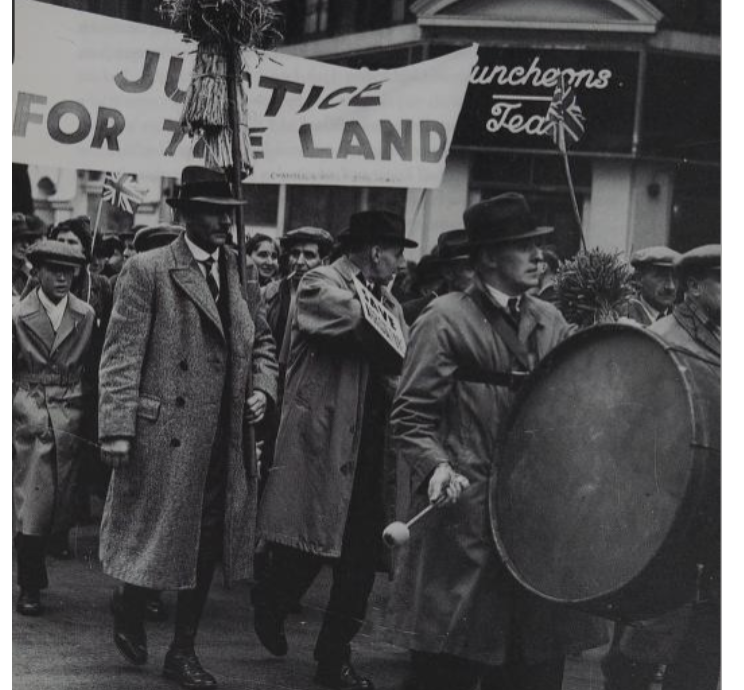
Parliament responded with the 1936 Tithe Bill, which abolished the tithe rent charges, and replaced them with yearly payments, or annuities, payable to the state for 60 years. The tithe-owners were compensated with government stocks paying interest which covered the amount they previously received in rentcharge.
The payments and receipts continued, but now managed by the government, and intended to eventually cancel out. Many landowners and tithe owners, including the Church, continued to receive payments through this ancient and antiquated system for producing income from owning rights in land, until it finally came to an end in the 1970s.
LANDED (COCKERSAND TO BOWLAND): further research